


Nick Croft
More than 30 years experience in the sport of Triathlon
NICK CROFT THE ATHLETE
Nick Croft’s past and current athletic profile, including race result highlights and experience / qualifications, spans more than 35 years in the sport of triathlon. In the leading role of head coach at Multisport Consultants, Nick’s experience and depth of actual race knowledge can help lift your performance to the next level.
Nick Croft competing at Ironman FranceNick has an Ironman PB of 8.26 as well as an 8.48 at one of hardest Ironman events in Lanzarote (Spain). He’s been a regular columnist in publications such as Australian Triathlete, Runners World Australia, and Triathlon Sports Magazine. His wealth of experience has been in demand throughout the past few years, co-commentating on various triathlon events both live and on international TV broadcasts.
The majority of the athletes coached at Multisport Consultants are age group amateurs but Nick Croft has also worked with a successful mix of professionals and continues to do so. An even mix of the athletes that Nick works with compete in Ironman, sprint or Olympic distance events. At any one time a handful of athletes are in their first season of competition.
QUALIFICATIONS AND AWARDS
-
-
- Accredited Triathlon and Swim Coach
- Triathlon Australia QLD State Development Officer
- 2005 Triathlon Australia Ironman Coach of the Year Award
-

CAREER ACHIEVEMENTS
Nick competed in his first Triathlon in 1984, on Australia’s Gold Coast, as a 17-year-old. It was a 400m swim / 12km bike / 4km run. A small club event but an overall win made the debut all the more memorable. In March 1985 the first venture into Olympic distance saw a victory over an experienced field at Mooloolaba on Queensland’s Sunshine Coast. The Time of 1.58 was not bad at the time but it was the 3-minute victory over the Noosa Triathlon 3rd place getter from 1984 that had some established elite’s taking notice. Later that year, winning Noosa in a record time showed that the initial victory earlier that year was no fluke. By the end of that 1985/86 season Nick had added numerous wins to the list but it was the Australian Long Course Championships that was the major standout so far in his career to that point.
By the late 80’s Nick had established himself as one of the best in Australia and traded wins with Brad Beven, Stephen Foster, Greg Welch and Greg Stewart. By 1991 the overseas circuit was calling and between 1991 and 1995 Nick lived France for part of the season and had some standout races. Winning the ITU Cup in China in 1991 came after a solid season of racing in Australia, which saw Nick take out the Australian Triathlete of the Year Title as well finishing well up in the ITU World Cup Standings. He was also named men’s Captain of the World Championship team. In 1992 coming 5th at Nice in France was the highest placing by an Australian since Greg Stewarts 5th in 1987 and by the end of the season had won 4 more events and had established himself as one of the top Australian performers in Europe.
Another good European stint in 1993 saw Nick continue the good form and lead to his debut at Europe’s oldest Ironman event at Almere Holland. The time of 8.26 was the fastest by an Australian at the time on debut and signaled the desire to start to concentrate on long events from that point. Another solid Ironman 6 months later in Ironman Spain confirmed the potential and with that event came entry to Hawaii in 1994. A promising start with 3rd from the swim and second onto the road was wrecked by a new sponsored bike poorly set up. A valuable lesson learnt. Before the DNF, there was the buzz that came from leading the event and trade turns at the front with eventual winner, fellow Aussie Greg Welch. It was during this time that Nick started to have some health issues in the form of gastrointestinal upsets. From 1992 the problems started and intensified in 1993 but were controlled till 1995. It was then that Nick suffered a major blow that signaled the end of his professional athletic career.
Nick Croft – Professional Triathlete 1988 -1995
-
- Competed in over 130 Triathlons (1985-1995)
- 35 Out right victories
- 30 podiums (2nd / 3rd)
-
- 1995 Based in France, racing for French team Salon de Provence – 3rd place Triathlon de Valence (Season and professional triathlon career ended after this event due to illness).
- 1994 15th ITU World Long Course Championships – Nice France
- 1st Triathlon d’Avignon France
- 4th Lanzerote Ironman (Spain) – 8hrs.48min
- 1993 4th Almere Ironman (Holland) – 8hrs.26min – (fastest by Australian on debut)
– 1st Triathlon International de Jura (France) 2/80/20
– 1st Triathlon de Bessege (France)
– 5th Nice International Triathlon
– 2nd French Long Distance Championships
– 3rd Australian Long Course Championships
– 1992 1st Triathlon de Corsica (France)
– Captain Australian World Championship team Muskoka (Canada)
– 1st Triathlon d’Ancone (France)
– 3rd ITU World Cup Moscow
– 2nd Triathlon International Grenoble/ Alpe d’heuz
– 5th Triathlon International Nice
– 2nd Australian Long course Championships
– 1st Sri Chinmoy Triathlon Canberra
– 1st Geelong National Tour race
– 1991 Captain Australian team World Championships
– 1st Beijing ITU World Cup (China)
– Winner Australian Triathlon Series
– Australian Triathlete of the Year
– 11th Place ITU World Cup Series
– 1990 Winner 6 events
– 2nd Noosa Triathlon
– 1989 Member 1990 Commonwealth Games Triathlon Team – Auckland New Zealand
– 2nd Noosa Triathlon
– Member first official Australian (winning) team at inaugural ITU World Triathlon Championships, Avignon, France
– 2nd Australian Long Course Championships Canberra
– Winner – 6 events
– 1985-88 Winner 20 events – including:-
– 2 times QLD Triathlon Champion
– South Australian Champion
– 2nd VIC Championship
– 2nd NSW Championships
– 1986 Australian Long Course Champion
– 2 Times Noosa Triathlon Champion
Want to improve your triathlon experience?
Want to improve? To find out more about how Multisport Consultants can help improve your race splits with a specific training program > click here, or if you feel you may require a more personalised training program, contact Multisport Consultants for more details.
An important part of any swim program is adding variation and using swim aids at times in each session, rather than just swimming constant lap after lap freestyle.
Overcoming Serious Illness
How would it feel to be so weak that you were unable to get out of bed to go to the window to have a look outside? Or have diarrhea so bad that you were going to the toilet 30 times a day all while passing blood with each visit!
Nick Croft in hospital after suffering from infectious ColitisThis was what former professional triathlete Nick Croft at 27 years of age in 1995 was faced with during his 4th season of racing in France. In July of 1999 Nicks battle with his intestinal problems ended when his large intestine was surgically removed in a 4 hour operation at Royal Brisbane Hospital.
A four-month stint with a colostomy bag ensued until a second operation in November 1999 completed the 2-stage operation. A new intestine was fashioned from the last 23 inches of Nick’s small intestine to make a “W” pouch during the first operation, which over time will slowly adapt to the role of the large intestine.
Nothing much has been said of Nicks demise from the World and Australian scenes. “People still come and ask if I just decided to pull the pin” says Nick as to why he doesn’t compete any more. The truth of the matter is that, the inflammatory bowel disease (IBD) – Ulcerative Colitis, struck down Croft only 2 weeks after arriving for his French club Salon de Provence in 1995. He spent 8 weeks in hospital, which saw his weight plummet from 72 to 58kg and in fact nearly lose his life. “I spent 5 days in intensive care and had to be fed via a central line in my neck as I couldn’t eat”. “At the time the French doctors diagnosed me as having infectious Colitis, that is I picked it up perhaps through contaminated water”. Croft was released once he was strong enough to make the trip back to Australia but after a month was readmitted to a Brisbane hospital with a fever and the symptoms starting again.

It was then that the Doctors made the diagnosis as Ulcerative Colitis. The disease is an inflammation of the mucous membrane layer of the colon. The disease is not contagious and is thought that individuals that contract it may have an underlying genetic predisposition to it. One of many theories is that they come into contact with an infectious agent. Anyone can get Inflammatory Bowel Disease, but young adults between the ages of 20 and 40 are most susceptible. Symptoms range from mild to severe and include any or all of the following: persistent diarrhea, abdominal pain or cramps, passing blood, fever and weight loss and skin or eye irritations. Both the cause and cure for IBD are unknown.
Nick Croft recovering in hospitalTo treat it a variety of anti-inflammatory and Immunosuppressive drugs can be prescribed; including the cortio steroid Prednisone which itself can have some very nasty side effects. Surgery is reserved for patients that medication can no longer control the symptoms.
“The actual pain and mental torture that this disease places on the sufferer is simply one that cannot be described. At times it is best simply put as a living hell. All of this was devastating to Croft at the time, as it seemed that his professional triathlon career would be put on hold or possibly even terminated. “While I was in the French hospital I had planned out my whole next season of racing and training”. “I didn’t even enter my mind that this may be the end of the career”.
Nick felt as if he had only started, even though he had been around since the sports infancy in Australia and had over 130 triathlons under his belt with 35 wins and 30 podiums over distances across the board.
The 1986 Australian Long Course Champion and 2 time Noosa Triathlon winner had just started to venture to the Ironman distance, completing 2 events, making his debut at Europe’s oldest Ironman at Almere Holland in 8.26. He followed that up with a 4th at what is considered one of the hardest Ironman races on the circuit at Lanzorote in the Canary Islands in 8.48 in 1994. Even though the Disease struck Croft down in 1995 he started to have intestinal problems at the end of 1992 after his first European trip. “A few weeks after I returned to Australia, I started to have cramps and started to pass some blood when I went to the toilet”.
A visit to the local GP came up with a hemorrhoid and a subsequent Colonoscopy came up with possibly a touch of irritable bowel. “I went back to France in ’93 and again the symptoms returned, but much worse”. I was racing on a few occasions and had terrible diarrhea with the passing of blood and knew something wasn’t right. A Local Doctor gave me anti diarrhea medication and after 1 month the symptoms disappeared” A slow decline of health and race form and performances crept into Nicks racing during this period.
Nick Croft head coach of Multisport ConsultantsLooking back now, Nick feels that even though he was supremely fit his actual health was slowly deteriorating to the point that he wasn’t able to finish races for the first time in his career. “I had some shocking performances at times – especially in 1994 and early 1995 which can be in some part be I feel can be contributed to my impending time bomb”. When it looked like his pro career had run it’s course Nick found it a bitter pill to swallow. “There was a time that I just walked around in a daze still not being able to comprehend what was happening to me or the why me? Type thinking”. I had to make a decision as to what my next option was.
One of those was to decide whether to stay in the sport that had been so good to me or to move on”. He decided to stay.
Nick started coaching age groupers at the start of the 1995/96 season. “It was a tough transition but one I found my self really enjoying once my health stabilised”. Some of the drugs I had to stay on for life, but fortunately the Cortico – Steroids were only needed if I had a bad flare up”.
It was a constant battle right up to the surgery in 1999, as the nature of thedisease is to run a course of seemingly good heath for a while, than flare up. By April 1999 Nick had been on Prednisone for 5 Months straight due to an attack and was on a massive dose of 125mg per day with little effect. He was put in Royal Brisbane Hospital for a week to try and stabilise his health. “This is when Surgery was talked of for the first time. I’d be lying if I said that the thought of surgery didn’t scare me. I had gone down every natural medicine road there was. You name it I tried it – from Chinese medicine, to acupuncture, naturopaths, special diets, magic potions – I tried them all and listened toeveryone who gave me any hope.” The fact is, is that I had a physical disease that no natural medicine was going to cure.
Today Nick has built back up to a healthy 73kg and is back swimming, riding and running to stay fit. So will we see Nick Croft racing once again? In 2002 Nick made steps to racing again as an age grouper at the Cairns Half Ironman. It was shock to the system but a time of 4.35 was a step in the right direction and the health was good.
Nick Croft competing at the 2008 Noosa TriathlonTen weeks later and doing the Forster Half Ironman an age group win was achieved and a time of 4.20 with a 13th overall out of 900 participants really showed to Nick that maybe he could do this at an ok level again. An injury laid to rest the remainder of the season but the signs are there and the confidence is returning so hopefully an Ironman in the not to distant future is on the cards. “The last thing I want to do is wreck the good health I’ve managed to find again by jumping in to quick”. I’m still heavily involved in the sport with age group coaching and writing programs by correspondence and online.” Add to that, organising Triathlon Training Camps at Noosa, event commentary, doing the Weet-Bix Aussie Kids school visits and organising the Life Stream Triathlon Festival in Mackay, North Queensland, Nick has a lot on his plate.
Nick would finally like to thank those in the Triathlon community who sent theirsupport during the tough times. Hundreds of emails and cards came through and Nick attributes his quick recovery to this support along with a positive attitude.
“The Locals at Noosa have also been fantastic. “There’s a difference between being fit and being healthy – I was fit but very unhealthy. I hope I can be of some help to those out there with inflammatory bowel disease also.” There is always nsomebody out there worse off – I know because I saw these people during my hospital stays. I really do believe that I have been handed a gift, which haschanged my life for the better. It makes being an athlete, seem not so important anymore. I do know that I enjoy each day as it comes now”.
Want to improve your triathlon experience?
Want to improve? To find out more about how Multisport Consultants can help improve your race splits with a specific training program > click here, or if you feel you may require a more personalised training program, contact Multisport Consultants for more details.
Latest news from Multisport Consultants
-
 16December
Noosa Ironman Training Camp
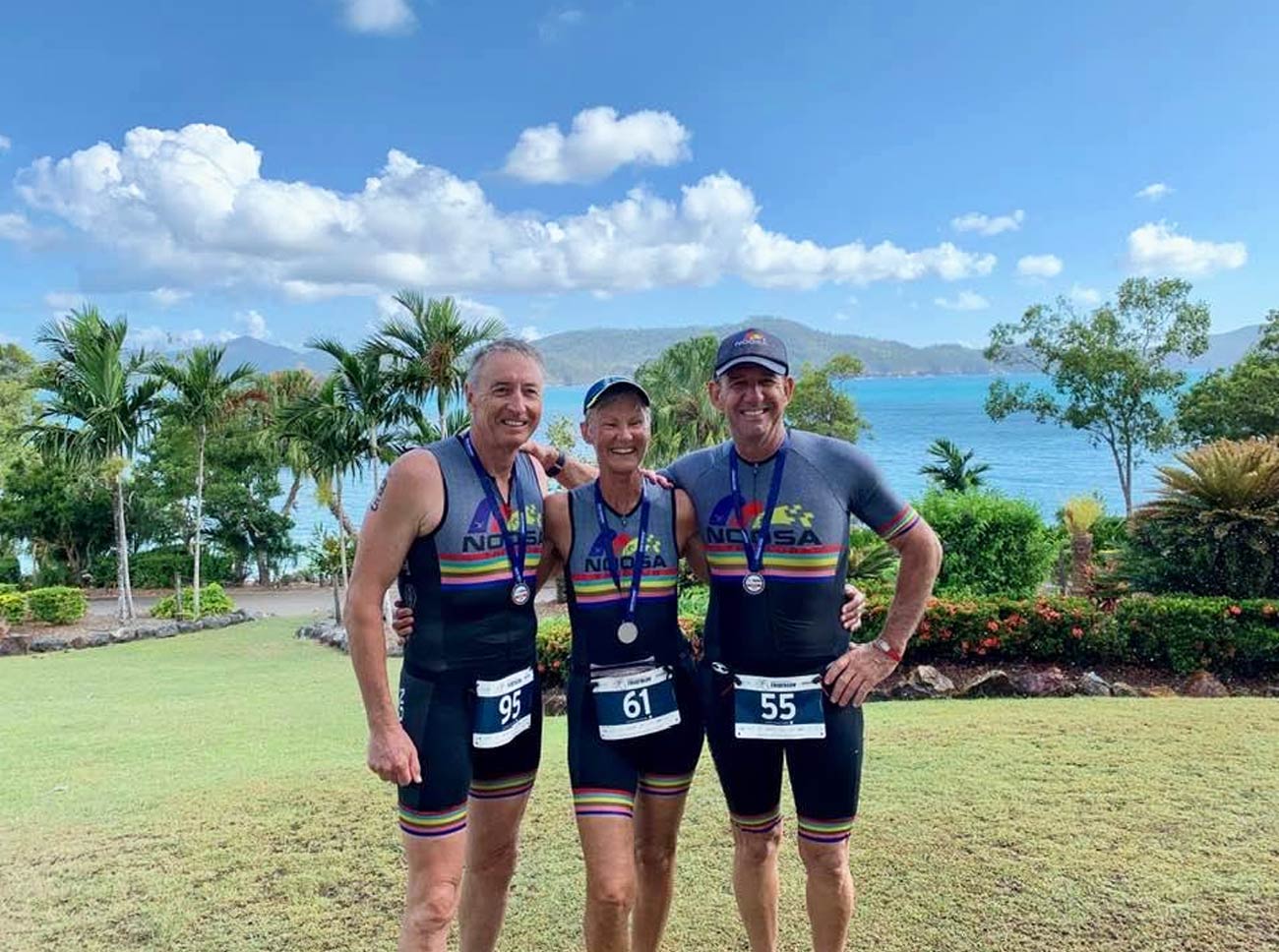
MSC crew Racing over the weekend just gone over 5 different events - In 70.3 Western Sydney – P
-
 02December
A big weekend of racing for MSC athletes
Quite a big weekend of racing for MSC athletes just passed as we hit December In Canberra at the
-
 05December
Perfect morning for a ride
Perfect morning for a ride. Last TT for 2019 and a good showing for it. Mark Preston was fastest tod